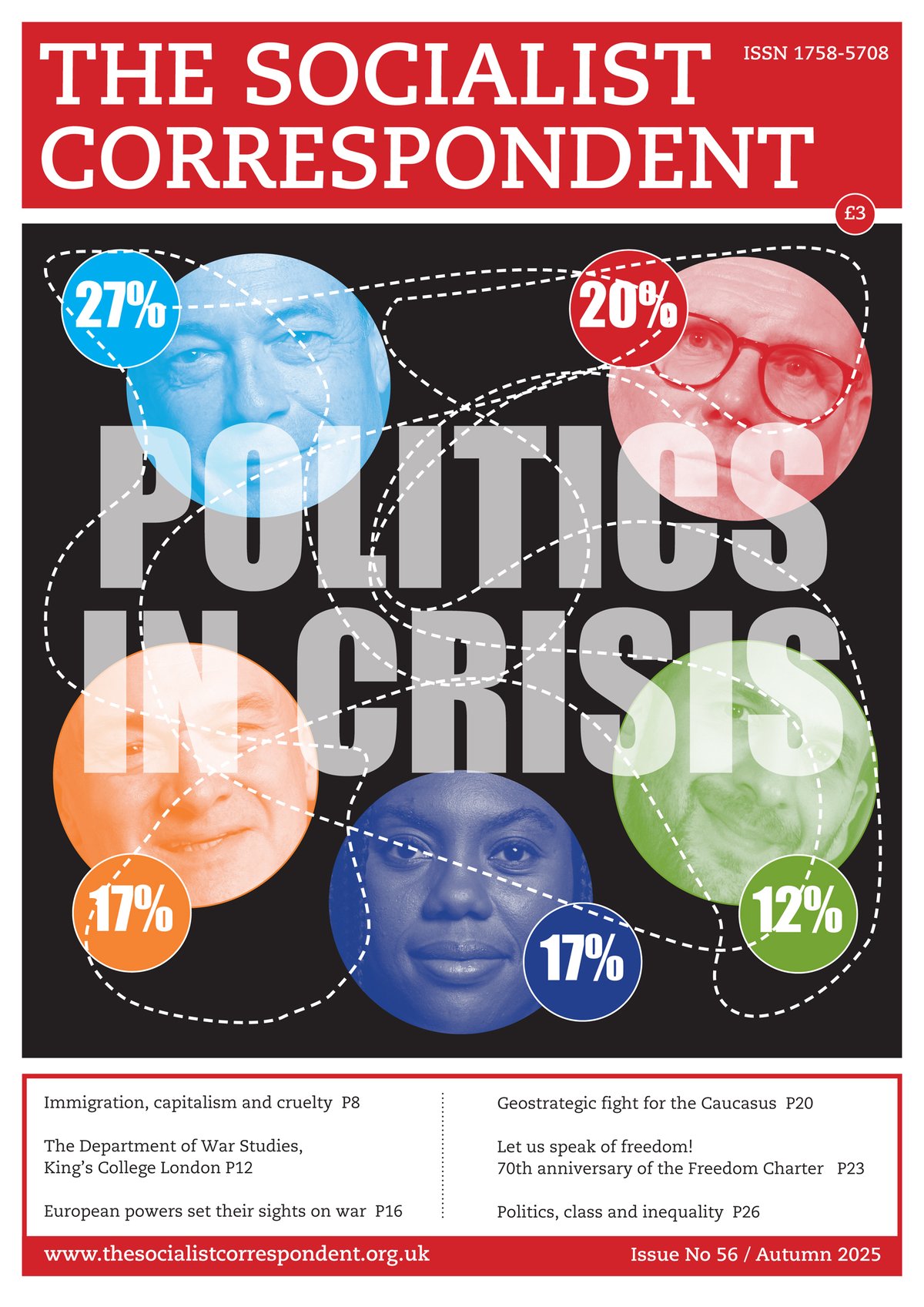
There is a crisis of the traditional parties of the establishment in Britain. Their support is declining and they are unable to convince the electorate that they deserve their votes when all they offer is more hardship. In Politics in crisis but the drive to war continues, Frieda Park explores the problems faced by Labour and the Tories and the challenge from Reform UK. The Tories are in an existential crisis and risk terminal decline but Labour has big problems too. In addition to Reform’s rise, other parties are eating into Labour’s vote from the centre-left. Yet the Labour leadership remains fixated on the challenge from the right, both validating the right’s narrative on immigration and driving left and liberal Labour voters into the arms of other parties. Having entered government with a stonking majority, Keir Starmer seems unable to gain the political initiative, relying instead on worn out neo-liberal policies.
Though there are few who believe Starmer is doing a good job, even on the right, nevertheless there is one area where the establishment is very pleased with his performance and that is in international affairs. He is ramping up arms spending while people continue to experience declining living standards and crumbling services. He has also been at the forefront of ensuring the war in Ukraine carries on and has supported Israel in its genocide against the Palestinians. He has tried to modify this latter position somewhat, for example by recognising Palestinian statehood, but fundamentally is still not taking steps, like an arms embargo, which might have a real and immediate impact on Israel. This is not a view shared by Labour members, who voted at their conference to reject the government position, recognising that a genocide is taking place and calling for an arms embargo and sanctions.
Of all Starmer’s policies those on international issues are the most dangerous for the working class as he drags us closer to war. It is, therefore, welcome that the TUC has reversed its previous backing for increased arms expenditure and that slogans such as “Welfare not Warfare” are becoming more current.
Immigration
The question of immigration is dealt with in more detail by Noah Tucker in Immigration, capitalism and cruelty. Immigrants are essential to the functioning of advanced capitalist countries. Immigration provides workers for industries such as social care, as well as more highly skilled jobs, and immigrants are therefore a source of exploitation and profit. The immigration system is used to provide these workers, to drive down wages and conditions in the formal and informal economies and to create divisions within the working class. But there is a distinction to be made between immigration, government policy, and immigrants themselves who are human beings and workers. Immigrants old and new, and settled communities, are all part of the British working class so in the battle against capital and for workers our primary objectives are to combat racism and to build solidarity and unity between these different groups.
War plans
The preparations for war continue as rhetoric increases round so-called threats, particularly from Russia and China. There is increasing evidence of false-flag operations designed to create the conditions for war. The role of one institution and its intimate links to the British state and military are explored by Clare Bailey in The Department of War Studies, King’s College London. She examines how pro-war narratives and policies are formed and fed into the public domain. The power of the establishment is laid bare and gives us an understanding of what the peace movement is up against in combating the relentless war propaganda in the media.
Of course, Britain is not alone in its preparations for war. In European powers set their sights on war, Simon Korner looks at the bigger picture on the continent. Arms spending is being massively increased and Germany is aiming to take a lead in aggressive military posturing. It will partly pay for this by its ability to exploit EU markets. Though they are ultimately both subservient to US interests, Germany’s move to become the leading military power in Europe creates tensions with the other big power in the EU, France. The threat of war, however, is not diminished by these differences as both countries increase arms expenditure and are agreed on the drive to war.
Let us speak of freedom!
In the grim world situation in which we find ourselves, it is good to be reminded that things were not always so negative. Alex Davidson writes about a key moment in the history of the struggle against Apartheid in South Africa in Let us speak of freedom! 70th anniversary of the Freedom Charter. The process of writing the Freedom Charter brought together anti-Apartheid forces representing all races, and the final document was drafted on the basis of massive input from across the population. The result laid out the foundational requirements for a democratic South Africa. It was a short and clear declaration of the principles of a non-racial South Africa, of unity in struggle and of the right of people to economic, political and legal equality.
Past struggles remain a source of learning and hope for the future.