As the US prepares for war with China, it is exerting enormous pressure on its allies to re-arm and the re-armament drive forced on them is feeding their own individual long-term ambitions and appetite for war.
European leaders plan war
As the US prepares for war with China, it is exerting enormous pressure on its allies to re-arm. Germany, France and Britain have all raised their defence budgets towards the 5% of GDP stipulated by NATO. The aim of the US is to consolidate a single military and economic bloc under its full control. The European allies are to continue funding and organising the war against Russia, keeping it tied down, while the US focuses on China.
In this division of labour, Europe has so far spent $95 billion on the Ukraine war, far more than the US’s $75 billion, with 63% of European arms spending going on US-made weapons. The Europeans’ call for a US ‘backstop’ in Ukraine is a desperate attempt to keep the US engaged in its outsourced war. But even as the allies do the US’s bidding, the re-armament drive forced on them is feeding their own individual long-term ambitions and appetite for war.
Germany’s steep rise in arms spending began in 2022 immediately following Russia’s intervention in Ukraine. The then Chancellor Scholz announced a Zeitenwende, a watershed moment – increasing arms expenditure from €65 billion to €100 billion and jettisoning Germany’s principle of not delivering weapons to a country at war. The current Chancellor, Merz, is accelerating the process, having pushed through a constitutional change to scrap the ‘debt brake’ on German borrowing, so that Germany can now borrow billions for weapons procurement. Over the next five years, Germany will be investing an estimated €1 trillion in arms production and related infrastructure, making it the biggest spender in Europe and the fourth biggest in the world. It is the largest German armament programme since World War 2.
This militarisation is evidence of Germany transforming itself into a belligerent power once again. The country’s top general has promised that Germany will be war-ready by 2029, which means reintroducing conscription. Germany is also lobbying for nuclear-sharing arrangements with NATO’s nuclear powers, with the aim of joining the nuclear club, and pushing for a seat on the UN Security Council commensurate with its global status. Former foreign minister Annalena Baerbock’s recent appointment as president of the UN General Assembly is a step towards Germany’s goal.
Progressive academic Thomas Fazi points out that Germany’s re-armament programme differs from anything since World War 2, not only in monetary terms, but in the way the whole of society is being prepared for war. Fazi says, “Merz’s vision is one of total mobilisation — a ‘whole-of-society’ approach that seeks to prepare not just the armed forces, but the entire German economy and civil infrastructure for confrontation with Russia. Media, education, industrial policy and civil defence are all being aligned to support this new war footing.” Government rhetoric talks up the Russian ‘threat’, while German missiles are being sent to Ukraine with all restrictions on their range lifted.
Destroying socialism, preparing for war
The reorientation away from Germany’s peaceful postwar constitution – which had been constrained in the way Japan’s had been – had its beginnings in 1990. The fall of the Berlin Wall, which immiserated the former East German population (life expectancy sank for several years afterwards) stimulated the united Germany’s ambitions to regain its status as a great military power. With the annexation of the German Democratic Republic, Germany at a stroke overtook France as the leading power on the Continent. Unification handed German capitalists an advanced socialist industrial base to plunder and a highly educated workforce to exploit. Over the following decade Germany achieved its aim of EU enlargement, fuelling its economy further by incorporating eastern and central Europe’s markets, resources and large pool of cheap labour, a process that is ongoing.
Immediately after re-unification, Germany began offensive military operations abroad. It participated in the Iraq invasion Desert Storm in 1991, funding the war to the tune of $10 billion out of a total $61 billion. It also led the dismemberment of Yugoslavia, which began in the same year, by early recognition of Croatian and Slovenian independence. It sent troops to Afghanistan and Mali, and in 2014 intervened in Ukraine by undermining Ukraine’s elected president Yanukovych and then siding with the Kiev coup government against the Donbas rebellion.
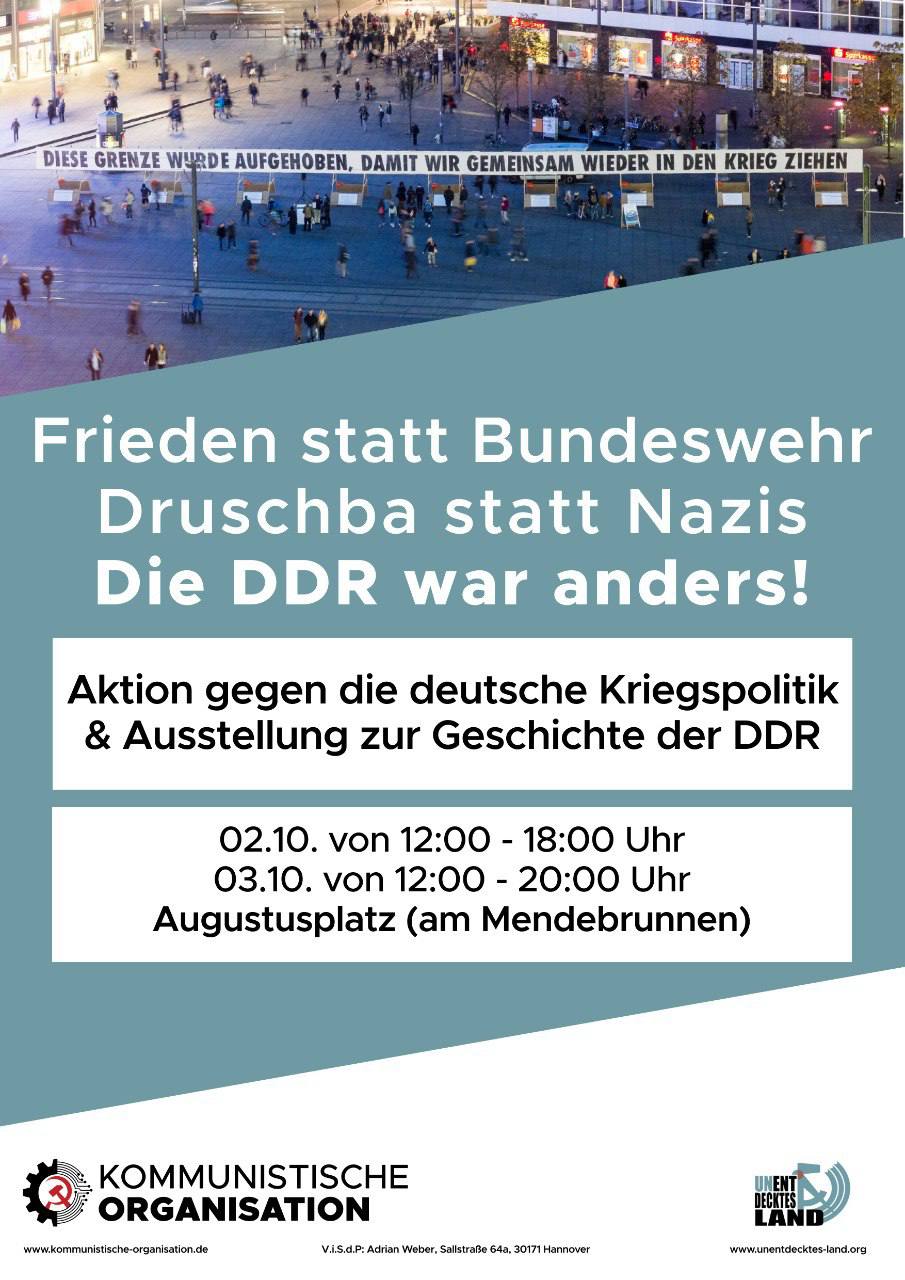
In 2022, after Russia sent troops into Ukraine to stop NATO’s eastward expansion, Germany became one of the most bellicose anti-Russian western powers. A leading supporter of the Ukrainian regime, it rapidly sent anti-tank weapons and Stinger missiles, and later dispatched Leopard tanks to the frontline as well as missiles whose range kept increasing, in the belief that Russia would succumb rapidly to concerted western power. A large protest banner displayed on the Day of German Unity in 2023 in Leipzig underlined the new order, “This border was lifted so that we can go to war together again.” War was precisely what the socialist, anti-fascist half of Germany existed to prevent. With that impediment removed, Germany could rise again.
Reality in Ukraine turned out differently from western expectations. Russia didn’t collapse but, rather, made advances on the ground, which are continuing. Yet despite Russia’s gains, Germany has not let up. Along with France and Britain, it is pressing forward with the formation of the so-called Coalition of the Willing.
While the Coalition is an American instrument designed to over-extend Russia and relieve the US of the burden of underwriting the conflict, it also expresses the interests of each of the Coalition partners in escalating the war. Each European power wants access to Ukraine’s rare earths and coal, rich agriculture, transportation hubs and cheap labour – Germany’s Rheinmetall arms-manufacturer has already built a factory in Ukraine to profit from rock-bottom labour costs and as a result its share price has risen 2000% since before the war. Each power is chasing a share of the spoils and vying with the others to secure them. Each is profiting from the vast Ukrainian market for weapons. European oligarchs and their political representatives are enthusiastic warmongers in their own right, even as they follow America’s orders.
Leopard 2A5 tank
Europe’s subjugation
Despite the US’s hegemonic power, it needs to keep a close eye on its European allies to quash any potential challenge. Germany has, since World War 2, been “kept down” by NATO and by the biggest contingent of US forces on the continent, 40,000 strong, along with an unspecified number of US nuclear weapons on its territory. Britain likewise hosts US bases and nuclear weapons. Though Britain has its own nuclear weapons, has no control over their use.
While France has a degree more autonomy, it is rapidly losing ground to the US in its African protectorates and in 2021was barged aside before completing its major submarine deal with Australia.
Once the US decided that Germany’s relationship with China and Russia had reached unacceptable levels it acted decisively. China had become Germany’s most important export market in 2016 and Russia had been supplying Germany with 40% of its energy supplies before the war. In February 2022, Biden announced that he would “bring to an end” the part-German owned Nord Stream pipeline – and a few months later, the undersea pipeline was blown up. This act of war, confirmed as such by Lloyds of London, who used the fact to avoid paying out insurance, provoked no condemnation from Berlin. Germany was also instructed to replace Russian energy with far more expensive American liquified natural gas, leading to economic recession for the past 3 years. Germany has also complied with US orders to decouple its economy from China by prioritising Poland as a market for its exports. This crushing of German strategic independence was one of the US’s reasons for provoking war with Russia in the first place.
While Germany’s acceptance of US orders appears self-sabotaging, its ruling circles calculate that their interests are best served by giving in to US demands and entering the warlike bloc against Russia and China. An economic hit can be compensated for by squeezing its own fiefdom, the EU, which Germany dominates with its massive GDP, sucking in wealth from the other countries. A 2017 report by the Centre for European Policy found that Germany earned €1.9 trillion in the first 20 years after adopting the euro, while France lost €3.6 trillion and Italy €4.3 trillion. The foundations for this German dominance were laid by Walter Funk, the director of the Nazis’ Reichsbank who envisioned a European single market under German control. The current Bundesbank is a direct descendant of the wartime Reichsbank.
French-German rivalry
Like Germany, France has embarked on an unprecedented arms race, earmarking €413 billion for its military over the next 5 years. Macron has doubled defence spending since 2017 when he took office. While the increase is lower than Germany’s, France begins from a stronger position, with the most powerful armed forces and biggest arms production base in the EU. France also has the advantage over Germany of being the sole nuclear power on the European continent (it has 290 warheads deployed on submarines) and of having a seat on the UN Security Council. Its Pacific island territories make it the world’s second largest maritime power, and, despite recent setbacks, its economic control over 14 countries in western and central Africa via its Communauté Financière Africaine gives it a lucrative neo-colonial hinterland.
The rivalry and mutual suspicion – historically determined – between France and Germany mean that co-operation is unachievable. De Gaulle famously called France the ‘jockey’ and Germany the ‘horse’, meaning France should direct European policy powered by German economic growth. France has, since the 1963 Elysée Treaty which symbolized reconciliation between two European powers, used its military weight to offset German economic strength. But German reunification upset that balance, and France has struggled ever since to reassert its superiority. Nevertheless, France still believes in its natural entitlement to European leadership, acting as the guardian of European security – always in its own interests.
The two main areas of contention are energy and defence. On energy, France’s large-scale nuclear power infrastructure has made it less vulnerable than Germany to raised energy costs caused by European sanctions on Russia. France, pressing home its advantage, objects to Germany granting a massive €200 billion subsidy to its industry to pay for expensive US energy, accusing Germany of flouting EU rules on state aid.
On defence, collaboration between France and Germany over the development of next-generation aircraft fighters, the Future Combat Air System, Europe’s supposed flagship defence project, has stalled because of French plane maker Dassault’s insistence on remaining the “uncontested leader” of the project, and because of Germany’s purchase of US F-35s instead of French (or jointly produced) planes. The German purchases are part of its attempt to move towards nuclear power-sharing, as F-35s can carry nuclear bombs.
One French official said: “We are basically betting the future of the French defence industry on co-operation with Germany… What we do not agree to is that Germany decides unilaterally for us.”
On the joint tank project, the Main Ground Combat System (MGCS), Germany has been reluctant to commit fully because its Leopard tanks, battle-tested on the Ukraine frontline, have rendered the MGCS potentially redundant. Its recent order of 600 new Leopards for its army may sink the joint project altogether, which has anyway been dogged by disputes and delays.
On missile defence, Germany has joined the Sky Shield project with other European powers, leaving France out. The project covers the Baltic and east European countries, and France fears it will give Germany too much control over the region. There are similar differences over space weapons.
Other major issues of contention include an EU free trade deal with the Latin American countries in the Mercosur trade bloc. Germany favours the deal as a route to new export markets, but Macron fears agricultural dumping will hurt French farmers.
Another issue is Poland, busily re-arming itself to form the largest land army in Europe. France, which earlier regarded the enlargement of the EU to include Poland as evidence of German expansionism over its eastern neighbours, is now seeking to befriend Poland in order to extend its security hegemony over eastern Europe – and has hinted at providing Poland with the French nuclear umbrella. This jockeying is why the so-called Weimar Triangle triple alliance of France, Germany and Poland has consistently failed to progress.
Competition and division
For the same reasons of competition, the Coalition of the Willing is unlikely to succeed on the terms it has set itself – as a co-operative western venture to intervene with boots on the ground in Ukraine. Either France, Britain or Germany will seek to lead the other aggressors. A leaked French map of the division of Ukraine’s spoils reveals how they are planning to manage the ‘scramble’ – France wants the minerals, Britain wants control over the logistics hubs, and so on. It also highlights Polish, Romanian and Hungarian ambitions to seize Ukrainian territory they claim belongs to them.
European divisions have also made it easy for the US to impose punishing 15% tariffs on all European products – in a ‘deal’ made between the US and the EU Commission. The strategic capitulation on tariffs exposed the myth that by pooling their sovereignty into a supranational bloc, the European nations could stand up to the US. Instead, the EU has only intensified European competition, allowing the US to strengthen its hold over the continent. While Merz bemoaned the fact that the agreement would “substantially damage” his nation’s finances and Macron called it a “humiliation” for Europe, neither resisted it. While they talk about gaining strategic autonomy from the US, in reality, the ruling circles in each European country are confirmed Atlanticists riding on US power – look at VW and Mercedes shifting huge investments to the US while the Germany economy is deindustrialised.
To compete globally, both France and Germany need each other to achieve economies of scale and technology-sharing, but the contradictions between the two have made co-operation problematic. Despite the fact that there have been 25 meetings of the Franco-German Council of Ministers since 2003, and despite French and German ambitions to set up a joint defence and security council, co-operation hasn’t materialised in a meaningful way. Each power instead seeks to use the EU to promote the interests of its own capitalist class, ceding areas of national control to the unelected EU Commission in the hope of gaining an advantage for themselves. The Commission is in turn exploiting these divisions within the EU to grab power from the member states, with the aim of taking de facto control over European policy – for instance, when Ursula von der Leyen in 2022 went beyond her remit and assumed the role of EU commander in chief, in effect supervising the outsourcing of US warmongering in Europe.
In the longer term, re-armament has set the conditions for future European armed conflict – both against Russia, but also eventually between the European powers themselves – conducted by countries massively armed and nursing newly-fed ambitions. A re-militarised Germany with all spending restraints removed will seek to go it alone, outside French security ‘protection’. A heavily militarised France will never accept the renewal of German military power that has led to three invasions in 150 years.
As for Britain, its re-armament is perhaps even more dangerous, given the UK's record of active warmongering over the past two years alone – against Russia, China, Palestine, Syria, Yemen, Qatar and others.